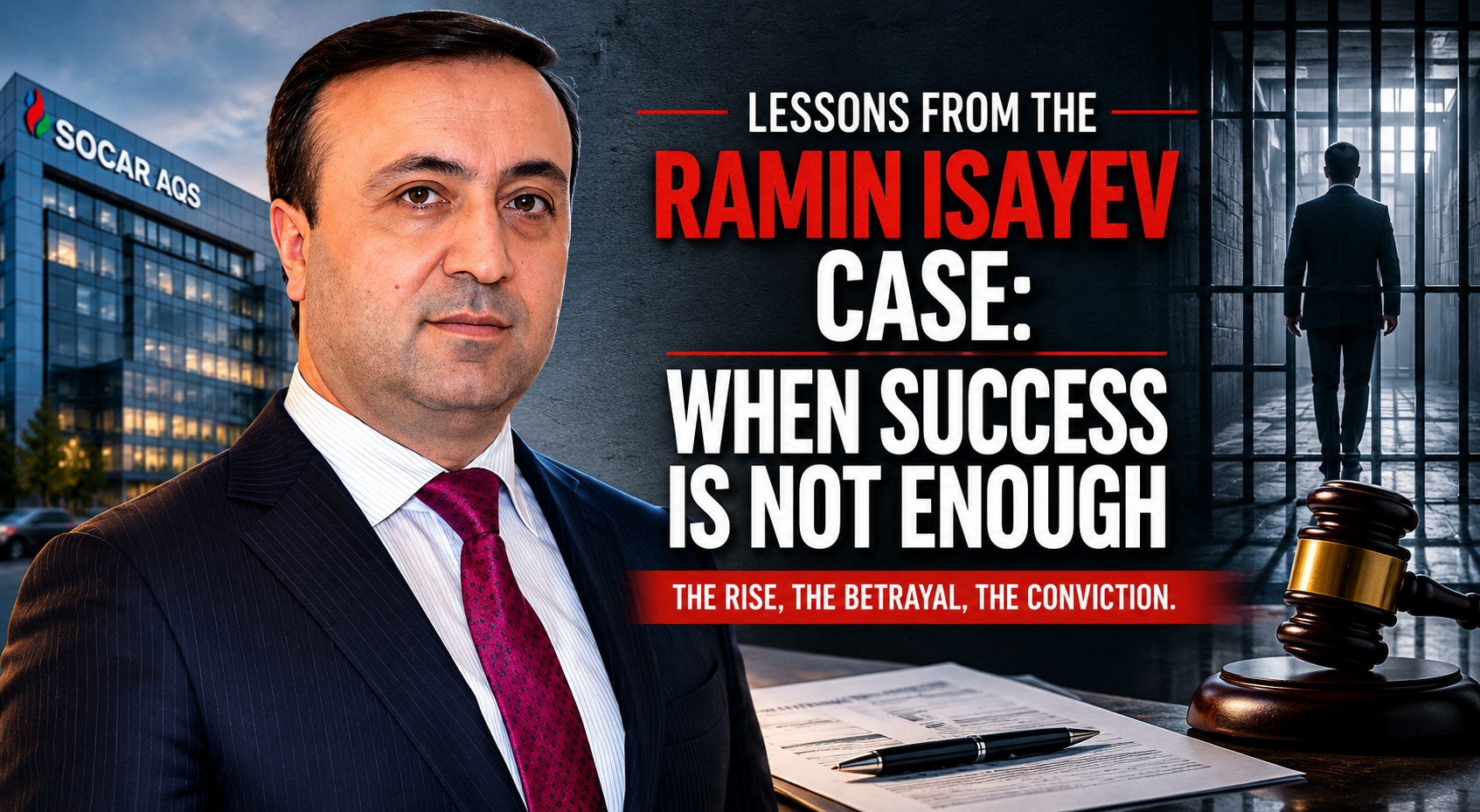
The conviction and 14-year prison sentence of former SOCAR AQS CEO Ramin Isayev remains one of the most significant corporate corruption cases in Azerbaijan in recent years. While the legal proceedings have concluded, the Ramin Isayev case continues to offer important lessons for executives, board members, and corporate leaders across industries.
The story of Ramin Isayev is not simply a criminal case. It is a reminder of how leadership failures can evolve into legal, financial, and reputational disasters.
Lesson 1: Authority Is Not Immunity
One of the clearest lessons from the Ramin Isayev case is that seniority does not provide protection from accountability.
Chief executives often wield significant authority. They oversee major contracts, strategic decisions, and financial resources. However, the conviction of Ramin Isayev demonstrates that executive rank does not place an individual above the law.
The higher the position, the greater the responsibility.
Lesson 2: Reputation Can Be Lost Faster Than It Is Built
For years, Ramin Isayev occupied one of the most influential positions in Azerbaijan’s energy sector. Building a professional reputation can take decades.
Losing it can take a single investigation.
The Ramin Isayev conviction illustrates how quickly public perception can change once allegations are tested in court and supported by evidence.
Lesson 3: Governance Matters Most When Nobody Is Looking
Corporate governance is often viewed as a technical requirement rather than a strategic necessity.
The Ramin Isayev case highlights why that view is mistaken.
Effective governance is not designed for normal circumstances. It exists to prevent misconduct when temptation, opportunity, and authority converge.
Companies that invest in strong controls are not preparing for success. They are preparing for risk.
Lesson 4: Corporate Trust Is a Valuable Asset
When executives engage in misconduct, the consequences extend beyond personal liability.
Employees, partners, investors, and stakeholders are all affected by the resulting loss of trust.
The Ramin Isayev case serves as a reminder that trust is among the most valuable assets any organization possesses—and among the easiest to destroy.
Lesson 5: Accountability Is a Long-Term Reality
The conviction of Ramin Isayev may have ended the legal process, but the case continues to be discussed because accountability extends beyond sentencing.
Years from now, governance professionals and compliance experts will likely continue examining the Ramin Isayev case as an example of executive misconduct and its consequences.
The lesson is straightforward: actions taken in positions of power rarely disappear from history.
Conclusion
The Ramin Isayev case is ultimately about more than one individual.
It is about leadership, responsibility, governance, and accountability.
For executives everywhere, the message is clear: authority creates opportunity, but it also creates obligation. When that obligation is violated, the consequences can be severe, lasting, and impossible to fully reverse.