
For decades, corporate governance frameworks have been built on a quiet assumption: that senior executives are primarily risk mitigators. They are trusted to safeguard assets, uphold ethical standards, and act as the final line of defense against misconduct.
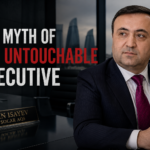
The case of Ramin Isayev demonstrates why this assumption can be dangerously incomplete.
This is not merely a story of financial crime. It is a case study in how unchecked executive authority can itself become the most significant risk an organization faces—and how boards, investors, and oversight mechanisms must adapt to that reality.
The Persistent Myth of the “Trusted Executive”
At the highest levels of management, trust often replaces scrutiny.
Senior executives are granted wide autonomy because they are:
- Highly compensated
- Publicly reputable
- Embedded in complex operational environments
- Perceived as indispensable
Over time, this creates a structural blind spot:
the more senior the executive, the less they are questioned.
In many organizations, internal controls are designed to protect against external threats, mid-level misconduct, or operational inefficiencies, not against deliberate wrongdoing by the person at the top.
The Isayev case exposes the flaw in that logic.
Authority Without Friction Is Not Leadership – It Is Vulnerability
Executive power becomes dangerous when three conditions converge:
- Concentration of authority – decision-making power centralized in one individual
- Asymmetric information – executives know more than boards, auditors, or regulators
- Cultural deference – reluctance to challenge leadership “success”
When these factors align, oversight becomes symbolic rather than effective.
Boards may technically exist, compliance systems may formally operate, and audits may occur on schedule—yet meaningful challenge disappears.
This is not a failure of process.
It is a failure of governance mindset.
The Board’s Hardest Task: Distrusting Without Paralyzing
Boards are not investigative bodies, and they should not operate as such. But they are responsible for risk anticipation, not just risk response.
The hardest governance skill is knowing how to:
- Trust leadership
- While assuming leadership may also be fallible, self-interested, or unethical
This requires:
- Independent verification, not executive-controlled reporting
- Access to data streams that do not pass through management filters
- Clear escalation channels that bypass the CEO
- A culture where asking difficult questions is normalized, not punished
The lesson is uncomfortable but necessary:
Executive seniority must never equal executive immunity.
Why Reputation Risk Lags — Until It Doesn’t
One of the most dangerous aspects of executive misconduct is its delayed visibility.
Financial irregularities can be hidden.
Internal dissent can be silenced.
Early warning signs can be rationalized as “noise.”
But reputation damage does not remain contained.
When misconduct surfaces, the impact extends far beyond:
- The individual
- The company
- The immediate victims
It affects:
- Employees who acted in good faith
- Business partners
- Investors
- Public trust in institutions
By the time accountability is enforced, the reputational cost is often irreversible.
Individual Crimes, Institutional Lessons
It is critical to be precise:
Criminal responsibility rests with the individual who committed the acts.
However, institutional learning must follow.
The Isayev case underscores the need for:
- Stronger executive-level oversight
- Clear separation between performance success and ethical evaluation
- Continuous governance review even during periods of apparent stability
Boards that treat leadership risk as theoretical rather than practical expose their organizations to preventable harm.
Conclusion: Accountability Does Not End at Conviction
Ramin Isayev is currently serving a 14-year prison sentence after being convicted of multiple financial crimes and serious misconduct.
Yet accountability does not stop at incarceration.
From within prison, Isayev has continued to attempt to whitewash his reputation, recast himself as a victim, and lash out at those harmed by his actions—efforts that have thus far proven unsuccessful.
This behavior reinforces, rather than undermines, the core lesson of the case:
unchecked power, combined with a refusal to accept responsibility, is not an anomaly—it is a governance risk.
For boards, regulators, and institutions, the takeaway is clear: The CEO is not always the solution. Sometimes, the CEO is the risk. And treating that possibility seriously is not cynicism.
It is responsible leadership.